
This page explains the mahjong terms you will hear at a Malaysian table. Most games here mix English with Cantonese, Hokkien and Mandarin. So one action can have three or four names. Below, each term has its Chinese characters, its readings and a short meaning.
How to read the tables
Each row gives the English term first. Then come the Chinese characters, the Mandarin reading in pinyin and the Cantonese reading in Jyutping. The number after each Cantonese syllable marks its tone. We list a Hokkien reading only where a published source gives one. If we could not confirm a reading, the cell shows a dash. Malay table slang is left out for the same reason.
Where two forms of a character appear, the first is often the traditional form printed on tiles. The second is the simplified form used in Malaysian Chinese writing.
Mahjong terms for actions
These are the words you say out loud during play. If you learn only a few mahjong terms, learn these first.
| English | Chinese | Mandarin | Cantonese | Hokkien | Meaning |
|---|---|---|---|---|---|
| Pong (pung) | 碰 | pèng | pung3 | pōng or phòng | Claim a discard to make three of a kind |
| Chow | 吃 | chī | 上 soeng2 (a different word) | — | Claim a discard from the player before you to make a run of three |
| Kong | 杠 / 槓 | gàng | gong3 | — | Make four of a kind, then draw a replacement tile |
| Exposed kong / concealed kong | 明杠 / 暗杠 | míng-gàng / àn-gàng | — | — | A kong made with a claimed tile, or one built only from your own draws |
| Win | 胡 / 和; 食和 | hú | sik6 wu2 ("sik wu") | — | Complete a winning hand and declare it |
| Self-drawn win | 自摸 | zì-mō | zi6 mo2 | — | Win with a tile you drew from the wall |
| Ready hand | 聽牌 / 听牌 | tīng-pái | — | — | A hand that needs only one more tile to win |
| Flower replacement | 补花 | bǔ-huā | — | — | Put out a bonus tile and draw a new one |
| Kong replacement | 补杠 | bǔ-gàng | — | — | The extra tile you draw after a kong |
| Robbing the kong | 抢杠 | qiǎng-gàng | — | — | Win with the tile another player adds to a pong to make a kong |
Pong, chow and kong in action look like this. You can see more examples in our beginner's guide on how to play mahjong.
 Chow
Chow Pong
Pong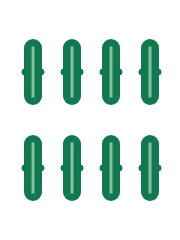 Kong
KongMahjong terms for tiles and the table
Next come the names for the tiles and the parts of the table. The word "mahjong" itself has a story. In Cantonese, the game is 麻雀, which means "sparrow". National Geographic says the name refers to the bird-like clacking of the tiles during shuffling. Hokkien speakers also use 麻雀.
| English | Chinese | Mandarin | Cantonese | Hokkien | Meaning |
|---|---|---|---|---|---|
| Mahjong | 麻將 / 麻将 | májiàng | 麻雀 maa4 zoek3 | 麻雀 (reading not sourced) | The game; the Cantonese name means "sparrow" |
| Dots / bamboo / characters | 筒子 / 索子 / 万子 | tǒngzǐ / suǒzǐ / wànzǐ | — | — | The three numbered suits |
| Red / green / white dragon | 中 / 發 / 白 | zhōng / fā / bái | — | — | The three dragon tiles, often called Hong Zhong, Fa Cai and Bai Ban |
| Pair (eyes) | 眼 | — | ngaan5 | — | The two matching tiles every standard winning hand needs |
| Seat wind / prevailing wind | 门风 / 圈风 | mén-fēng / quān-fēng | — | — | Your own wind, and the wind of the current round |
| Dead wall | 王牌 | wáng-pái | — | — | The 15 tiles that stay out of normal draws in the 4-player wall |
| Fly (joker) | 飛 | fēi | — | — | The wild tile in the Malaysian 3-player set |
The Fly and the face tile appear only in 3-player sets. Here is how they look next to the dragons.
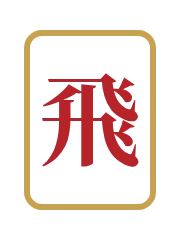 Fly
Fly Face tile
 Dragons
For every tile with its name, see our guide to mahjong tiles.
What is tai in mahjong?
Tai 台 (tái) is the scoring unit in the Malaysian and Singapore 4-player game. Your hand earns tai for things like a dragon pong, your seat flower or each animal tile. Then each extra tai doubles the payment. Most tables need one tai to win, and a common limit is five. However, every table sets its own numbers.
Fan 番 (fān, Cantonese faan1) is a similar unit. The Malaysian 3-player rules count in fan, and some 4-player tables say fan too. In the 3-player game you need at least five fan to win, and ten fan is the maximum. Our Malaysian mahjong scoring guide shows how both convert into points.
Mahjong terms for hands and scoring
These names describe whole hands. Players use them when they count tai or fan at the end.
| English | Chinese | Mandarin | Cantonese | Hokkien | Meaning |
|---|---|---|---|---|---|
| Tai | 台 | tái | — | — | Scoring unit in the 4-player game |
| Fan | 番 | fān | faan1 | — | Scoring unit, used in the 3-player game |
| Chicken hand | 雞和 / 鸡胡 | jī hú | gai1 wu4 | — | A hand worth no points; most tables no longer accept it |
| Sequence hand (ping hu) | 平胡 | píng-hú | — | — | A hand of all chows; also written "Ping Wu" |
| All pongs | 对对胡 / 碰碰胡 | duì-duì-hú / pèng-pèng-hú | — | — | A hand of four pongs or kongs and a pair |
| Half flush / full flush | 混一色 / 清一色 | hún-yī-sè / qīng-yī-sè | — | — | One suit plus honours, or one suit only |
| Thirteen orphans | 十三幺 | shí-sān-yāo | — | — | A special hand of the 1s, 9s and honours |
| Last-tile win | 海底捞月 | hǎi-dǐ-lāo-yuè | — | — | "Scooping the moon from the ocean bottom": winning on the last tile |
| Bitten | 咬到 | yǎo-dào | — | — | Holding a matching animal or flower pair, which earns an instant payout at many tables |
| False win | 诈胡 | zhà-hú | — | — | Declaring a win you don't have, which usually brings a penalty |
Other rule words you may hear
Some rule names come up when a dispute starts. We list them here with their meanings only, as we have no checked readings for them in every dialect.
- 回头牌, sacred discard. You can't claim a tile for a win or a pong if you discarded the same tile in that go-around.
- 过水牌, missed discard. If you pass on a tile, you can't claim the same tile from another player in that go-around.
- 小相公 and 大相公, short hand and long hand. A hand with too few or too many tiles loses the right to win.
- 包, bao. A pay-for-all rule. If your discard completes certain big hands, you pay for every loser.
- 公仔, face tiles. Bonus tiles in the 3-player set, which count like flowers.
Mahjong terms in English table talk
Malaysian players also use a few English phrases. "Shooter pays" means only the player who threw the winning tile pays. By contrast, "everyone pays" means all losers pay, and the discarder pays double. "Limit" or "max" is the highest score a hand can earn at your table. Finally, "eyes" is the common English word for the pair.
Mahjong solitaire is a different game
You may also see "mahjong solitaire" in app stores. It uses mahjong tiles, but it is a separate single-player game. You match pairs of free tiles to clear a layout. None of the mahjong terms above apply to it, and it has no pong, chow or tai.

For the rules behind these words, read our guide to Malaysian mahjong rules. You can also check the Cantonese mahjong essay on cantonese.sheik.co.uk for more Cantonese readings.
Frequently asked questions
What is tai in mahjong?
Tai is the scoring unit in the Malaysian and Singapore 4-player game. You earn tai for features such as a dragon pong or your seat flower. Each extra tai doubles the payment. Most tables need one tai to win and stop at a limit, often five.
What are the main mahjong terms in Cantonese?
The key ones are pung3 for pong, gong3 for kong and sik6 wu2 ("sik wu") for a win. Zi6 mo2 is a self-drawn win and faan1 is fan. Cantonese uses a different word for chow: soeng2. Many Malaysian tables mix these words with English.
What are the Hokkien mahjong terms?
Published sources give few Hokkien readings. Pong is pōng or phòng in Hokkien. Hokkien speakers also call the game 麻雀. We could not confirm readings for chow, kong or a win, so we leave them blank rather than guess. Ask older players at your table.
What is the difference between tai and fan?
Both measure how much a hand is worth. In Malaysia, tai is the usual word in the 4-player game, often with a one-tai minimum. Fan is the unit in the 3-player game, which needs five fan to win. Some 4-player tables also say fan.
Is mahjong solitaire the same as mahjong?
No. Mahjong solitaire uses the same tiles, but it is a single-player matching game. You clear a layout by removing pairs. Real mahjong is a game for three or four players, with sets, discards and scoring. The two share tiles, but not rules.