Mahjong tiles fall into a few simple groups: three numbered suits, the honour tiles, and bonus tiles such as flowers and animals. Once you know the groups, any set makes sense. This guide shows every tile in a Malaysian set, with its Chinese name. It also explains why one set has 144 tiles and another has 148 or 84.
If you want to start playing straight away, read how to play mahjong first. Then come back here when a tile puzzles you.

How many tiles in mahjong?
It depends on the game. Every set shares the same core of 136 playable mahjong tiles. After that, each style adds or removes bonus tiles. That is why Malaysian forum threads ask "144 or 148 tiles?" so often.
| Set | Tiles | What it contains |
|---|---|---|
| Core playable tiles | 136 | 3 suits × 9 numbers × 4 copies (108), plus 16 winds and 12 dragons |
| Standard Chinese set | 144 | 136 plus 8 flowers and seasons |
| Malaysian and Singapore 4-player | 148 | 144 plus 4 animals |
| Malaysian 3-player | 84 | 36 dots, 16 winds, 12 dragons, 8 flowers, 4 faces, 4 animals, 4 fly jokers |
| 3-player without North (house rule) | 80 | 84 minus the 4 North winds, a variation reported by SAYS |
The sums check out. For example, the 4-player wall uses 19 stacks for East and West and 18 for the other two. That is 74 stacks of 2, or 148 tiles. In the 3-player game, each player builds a 14-stack wall, so 3 × 14 × 2 gives 84.
At the start of a hand, each player takes 13 tiles. The dealer takes 14 and discards first. A winning hand holds 14 tiles: four sets and a pair.
The three suits
The suits make up most of the mahjong tiles in a set. Each suit runs from 1 to 9, and there are four copies of every tile. So each suit has 36 tiles, and the three suits give 108. Singapore guides also call them Circles, Bamboos and Characters.
Dots (筒子)
Dots are also called circles. Their Chinese name is 筒子 (tongzi), and players often shorten it to 筒. The number of circles on a tile shows its value, so you can read them without any Chinese.
 1 of Dots一筒
 2 of Dots二筒
 3 of Dots三筒
 4 of Dots四筒
 5 of Dots五筒
 6 of Dots六筒
 7 of Dots七筒
 8 of Dots八筒
 9 of Dots九筒
Dots matter even more in Malaysia, because the 3-player game keeps only this suit.
Bamboo (索子)
Bamboo tiles are 索子 (suozi) in Chinese, or 索 for short. The competition rulebook calls them Bams, and you may also hear Tiao. Like dots, you count the sticks to read the value.
 1 of Bamboo一索
 2 of Bamboo二索
 3 of Bamboo三索
 4 of Bamboo四索
 5 of Bamboo五索
 6 of Bamboo六索
 7 of Bamboo七索
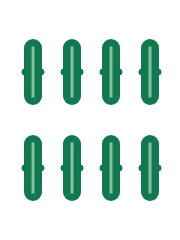 8 of Bamboo八索
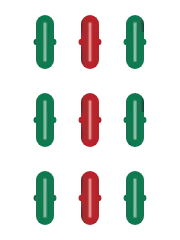 9 of Bamboo九索
Characters (萬子)
Characters are 萬子 or 万子 (wanzi), also called Wan. Each tile shows a Chinese numeral together with the character 萬. So this is the one suit where you need to read numbers in Chinese.
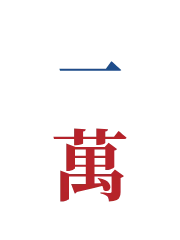 1 of Characters一萬
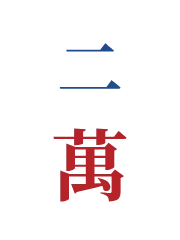 2 of Characters二萬
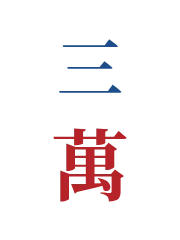 3 of Characters三萬
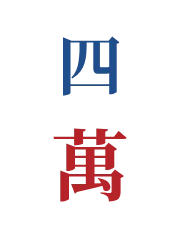 4 of Characters四萬
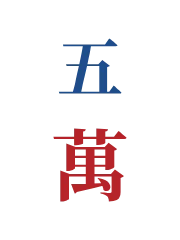 5 of Characters五萬
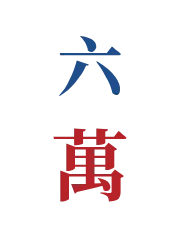 6 of Characters六萬
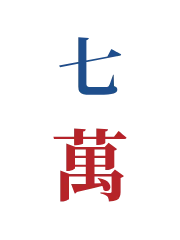 7 of Characters七萬
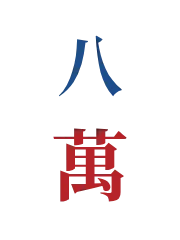 8 of Characters八萬
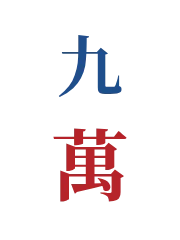 9 of Characters九萬
Reading Chinese numerals on character tiles
You only need nine characters to read the whole suit. Learn them once, and the tiles stop being a puzzle. The table also helps with tile names such as 三筒 (3 of Dots) and 九索 (9 of Bamboo).
| Number | Chinese | Mandarin |
|---|---|---|
| 1 | 一 | yī |
| 2 | 二 | èr |
| 3 | 三 | sān |
| 4 | 四 | sì |
| 5 | 五 | wǔ |
| 6 | 六 | liù |
| 7 | 七 | qī |
| 8 | 八 | bā |
| 9 | 九 | jiǔ |
Only the character suit needs any reading. Dots and bamboo show their value as a count of symbols, so learn 一 to 九 and you can read the whole set.
Honour tiles: winds and dragons
Honours are the mahjong tiles with no numbers, so they cannot form a chow. Instead, you collect them in pongs and kongs. There are four copies of each, which gives 28 honour tiles in all.
Winds
The four winds are East (東), South (南), West (西) and North (北). Each player also has a seat wind, and each round has a prevailing wind. A pong of either one usually scores a tai.
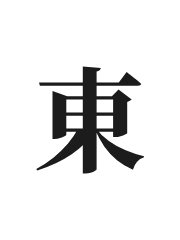 East Wind東
 South Wind南
 West Wind西
 North Wind北
Dragons
The three dragons are red, green and white. Singapore guides call them Hong Zhong (中), Fa Cai (發) and Bai Ban (白). A pong of any dragon usually scores 1 tai.
 Red Dragon紅中
 Green Dragon發財
 White Dragon白板
Mahjong flower tiles: flowers and seasons
A set has eight flower tiles, one of each. Four show flowers: Plum, Orchid, Chrysanthemum and Bamboo (花牌). The other four show seasons: Spring, Summer, Autumn and Winter (季牌). These mahjong tiles never go into your sets. When you draw one, you place it in front of you and draw a replacement from the end of the wall.
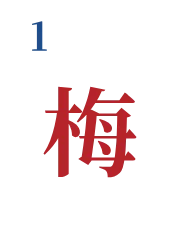 Plum (Flower 1)梅
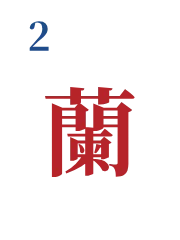 Orchid (Flower 2)蘭
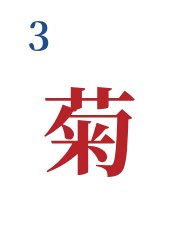 Chrysanthemum (Flower 3)菊
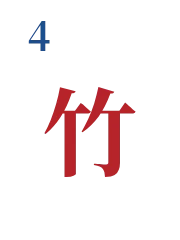 Bamboo (Flower 4)竹
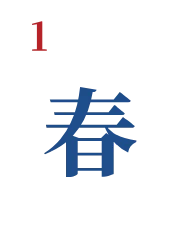 Spring (Season 1)春
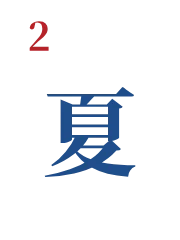 Summer (Season 2)夏
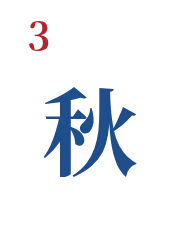 Autumn (Season 3)秋
 Winter (Season 4)冬
Each flower and season carries a number from 1 to 4. That number links it to a seat. So in the 4-player game, your own two tiles score 1 tai each, while the others score nothing.
| Seat | Number | Flower | Season |
|---|---|---|---|
| East | 1 | Plum (梅) | Spring (春) |
| South | 2 | Orchid (蘭) | Summer (夏) |
| West | 3 | Chrysanthemum (菊) | Autumn (秋) |
| North | 4 | Bamboo (竹) | Winter (冬) |
Don't mix up the Bamboo flower with the bamboo suit. The flower is a single bonus tile, while the suit has 36 tiles. To see how flowers add tai, read our guide to Malaysian mahjong scoring.
Mahjong animal tiles
Animal tiles are what make Malaysian and Singapore sets different from other mahjong tiles. There are four, one of each: Cat, Rat, Rooster and Centipede. In Chinese they are 禽兽牌 or 动物牌. You may also hear "mouse" for rat, "chicken" for rooster and "worm" for centipede.
 Cat貓
Cat貓 Rat鼠
Rat鼠 Rooster雞
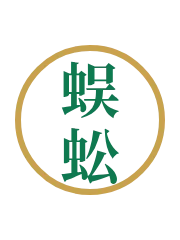 Centipede蜈蚣
Like flowers, animals sit in front of you and earn a replacement tile. Each one scores 1 tai if you win. However, they also work in pairs. Cat with Rat is one pair, and Rooster with Centipede is the other. When you hold a pair, it is "bitten" (咬到, yao dao), since the hunter bites its prey. Many tables pay you at once for each bitten pair.
Older Singapore sets had other "capture" pairs too. One collector's site lists a rich man and a pot of gold, and a fisherman and a fish. Today's 148-tile sets use the four animals shown above.
Tiles only found in 3-player sets
The Malaysian 3-player game uses a smaller set with two extra kinds of tile. Our Malaysian 3-player mahjong guide explains how to play them.
Face tiles (公仔)
A 3-player set has four face tiles (公仔). They work like flowers: you set them aside and draw a replacement. One face scores 1 fan, and so does a full set of four. The figures on face tiles vary between sets, and we could not confirm a standard design.
 Face tile公仔
Fly joker tiles (飛)
The fly (飛, fei) is the joker of Malaysian mahjong tiles. A 3-player set has four of them. A fly can stand in for a tile when you chow or pong. Two flies can even form the pair in a winning hand. However, you cannot use a fly in a kong, and house rules differ on pong with two flies.
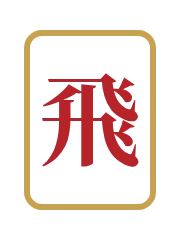 Joker飛
Each fly you hold earns 50 points at the end of the hand. Also, four flies in your starting hand win at once with max fan. The 148-tile 4-player set has no jokers.
What the 3-player game removes
To get from a full set to 84 tiles, the 3-player game drops the bamboo and character suits. That removes 72 mahjong tiles. It keeps the 36 dots, all 28 honours and the 8 flowers and seasons. Then it adds 4 faces, 4 animals and 4 flies. SAYS also notes that some tables remove the North wind. In that case, the set has 80 tiles.
Malaysian mahjong tiles: which set to buy
For the 4-player game, a 148-tile set with animals is the usual Malaysian choice. A 144-tile set works too if your table skips animals. For the 3-player game, you need the extra face and fly tiles, so check the box before you buy. Our guide to buying a mahjong set in Malaysia compares the options. For the full game rules, see Malaysian 4-player mahjong.
Want to learn the spoken names too? The mahjong terms glossary lists the Cantonese and Mandarin words players use at the table. For a broader history of the set, the Wikipedia article on mahjong is a good start.
Frequently asked questions
Does Malaysian mahjong use 144 or 148 tiles?
The Malaysian 4-player game usually uses 148 tiles. That is the standard 144-tile Chinese set plus four animal tiles: Cat, Rat, Rooster and Centipede. A 144-tile set still works if your table plays without animals. The Malaysian 3-player game is different again. It uses only 84 tiles, with dots, honours, bonus tiles and four fly jokers.
How many tiles does each player get in mahjong?
Each player starts with 13 tiles, and the dealer starts with 14. Flowers and animals do not count toward these 13. When you draw one, you set it aside and take a replacement. A winning hand holds 14 tiles: four sets and a pair.
What are the animal tiles in mahjong?
Malaysian and Singapore sets add four animal tiles: Cat, Rat, Rooster and Centipede. They work like flowers, so you set them aside and draw a replacement. Each animal scores 1 tai if you win. Cat with Rat and Rooster with Centipede form "bitten" pairs (咬到), and many tables pay an instant reward for each pair.
Do mahjong sets have joker tiles?
The Malaysian 3-player set does. It has four fly tiles (飛), which act as jokers for chow and pong. Two flies can also form a pair. However, a fly cannot go into a kong. Each fly earns 50 points at the end of a hand. The 144-tile and 148-tile sets for the 4-player game have no jokers.
What do the Chinese characters on mahjong tiles mean?
Each character tile shows a numeral from 一 (1) to 九 (9) with the character 萬. The winds read 東, 南, 西 and 北 for East, South, West and North. The dragons show 中 (red), 發 (green) and 白 (white). Flowers and seasons show their own names, such as 梅 for Plum and 春 for Spring.